
Oslo, Norway. A house that has read English and chosen to answer in Norwegian.
There are hotel rooms built for sleeping in, and hotel rooms built for being in. Oslo has long had an abundance of the former. The recipe is often a form of shutting daylight out: a plain roller blind, or grey film on the glass so that daylight arrives as a copy of itself. A light switch that cost twelve kroner, and a capsule machine with two capsules beside it. Three, if you're lucky. Savoy, on Universitetsgata, does none of this. It is not a small difference. It is the whole difference.
The Place
The building came first. The Watt building was raised from 1916, designed by R. E. Jacobsen for A/S Watt, which ran shops and offices here. The hotel opened in 1918 and has kept the year in its name, the way one keeps an heirloom one knows to be worth something. Through the interwar years and well into the postwar era, artists and writers gathered here, and Savoy Bar became a name that outlived the hotel around it. As bars do when they are good enough. In 2024 the house closed for fourteen months of rebuilding. Glastad owns it, HEIMR Collection operates it, Kritt Arkitekter drew it, and Metropolis Architecture & Design and Bielke&Yang have done the rest. Ninety rooms: nine square metres at the smallest, ninety at the largest. The simplest way to ruin a project like this is to decide that it should be English. You end up with panelling that bears no load, an oil-painted gun dog above a fireplace that never burns, a library without books, and a receptionist who says “madam” to travellers from Stavanger. The industry is full of Cotswolds manor houses in costume, set down in cities that never had manors. Savoy has read English and declined to dress up. The reference is there: the name, the porcelain, the austerity, and the idea that each room should have its own mood rather than being number 412 of the same variant. But the light is Nordic, because someone has left it alone. Nor has the house been made larger than it is. No one has tried to stretch the façade onto Universitetsgata into anything other than what it is: a small building, in a city where ambition is usually measured in storeys. The little figures drawn in ballpoint pen, which turn up in printed matter and signage, are looser in the hand than anything else in here. It is in distances like this that Savoy becomes itself.
The Rooms
The windows have fabric curtains and nothing else. No film, no frosting of the glass against the street. Daylight comes in as it really is outside, changing through the day. This is free. It is almost odd that more people don't do it. The bathroom is built from solid white tiles, an English porcelain basin and a single gleaming fitting. It is the base around which everything else is built. There are two ways to spend money on a bathroom: add functions, or pay to make sure the four things that are there are right. Savoy has chosen the latter, which is the expensive one. On the chest of drawers stand a kettle, two small French press pots and two paper bags of ground coffee. A pointed counterpoint to the capsule machine. The set-up signals craft, even if you never use it. If you prefer tea, good options are laid out as well. Everything can be enjoyed in the house's own cups. The corner rooms follow Savoy's original 1918 floor plan. The Watt Suite sits at the top: ninety square metres with its own bedroom and dining table. Classic Petite is a bed, a window and just enough floor, and is not treated as a lesser room. The light switch there is the same as in the suite. That is where you see who has done the sums.
The Table
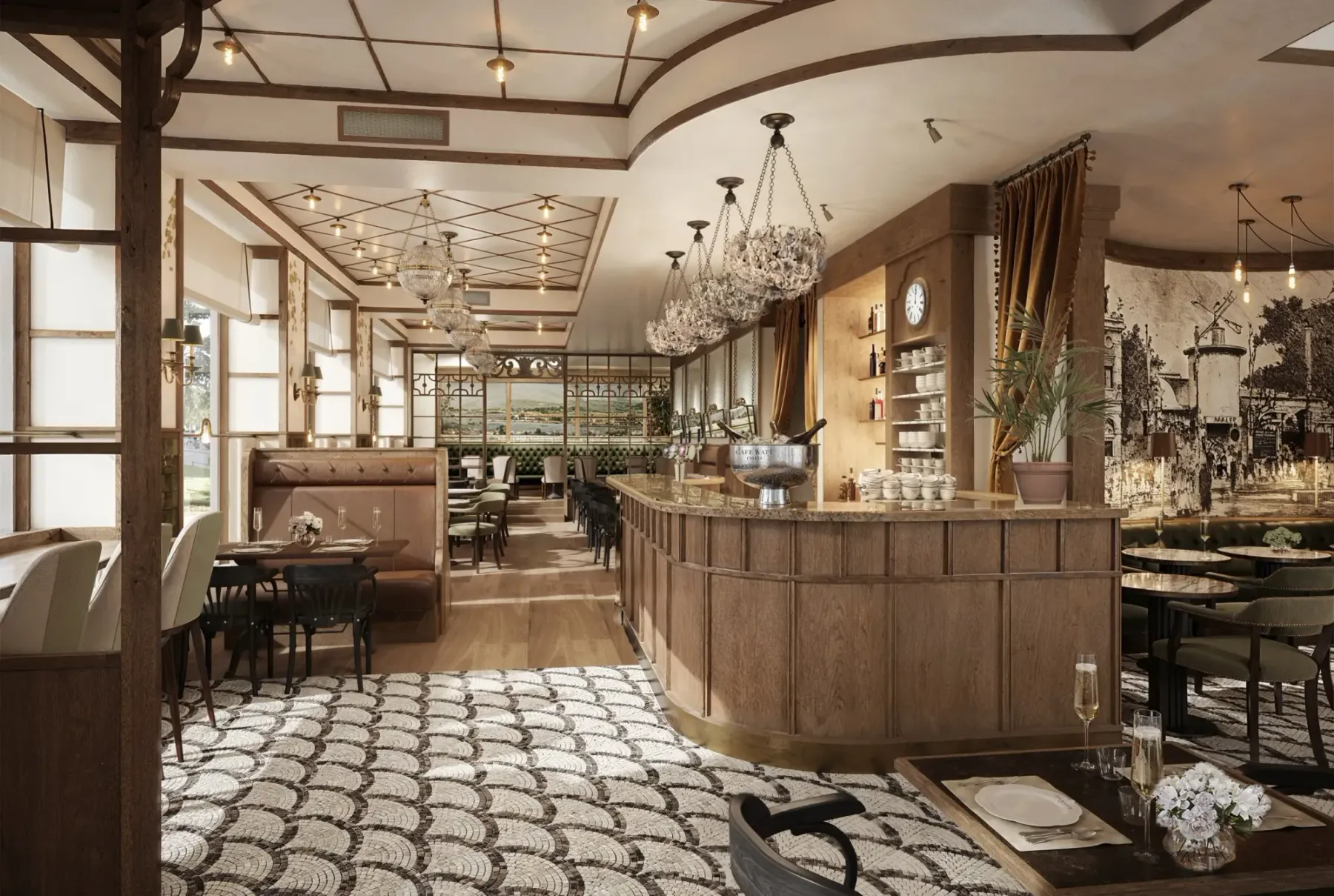
Breakfast is served in Cafe Watt, which is also the restaurant in the evening. Same room, same light, same people. From reception there is no door in, only a transition, and yet the sound is different on the other side. That is harder to achieve than a wall. The tables stand far enough apart that the neighbouring table's conversation stays the neighbouring table's. The room fills without becoming full, which is as much an operating decision as an interior one: someone has accepted fewer covers. The music is Nordic and plays so low that you have to decide to hear it. No radio station. Someone has sat down and chosen every track. The courtyard is the other place. A courtyard in the middle of Oslo, with English hints in the planting and furnishing, and a street level that doesn't quite reach in. Savoy Bar has been restored under its old name, and the name draws the city into the house without the city needing to live there. It is the place to be seen. The courtyard is the place to let go.
The Detail
The detail at Savoy is craftsmanship. Two tassels hang in the room. One means you want the room made up, the other that you want to sleep. Everywhere else in the world this is a two-sided plastic sign, often with an illustration of a bed and a sleeping moon. Here it is textile, and it is a decision made by a person who has held both options in their hand. Then there is the breakfast plate. Before the food arrives, it says God morgen kjære Oslo (“Good morning, dear Oslo”) along the rim, in the hotel's own script. Note what the sentence does not say. Not welcome. Not to our dear guest. Nothing about you. Someone has commissioned bespoke porcelain to greet the city outside the window, with the guests as incidental witnesses. It is the most English thing in the house. It is written in Norwegian.
Why Visit
Because it is possible to stay in a house that is the size of itself, with the same quality in the light switch as in the lobby, and because someone walks you to the lift on your way to something else and talks about the weather while doing so. I have only been there on warm days, with the courtyard open. That is probably the worst season in which to judge the place. A house like this is made for November. For the moment you come in from a wet Universitetsgata and discover that the room is warm before you have taken anything off. Savoy. It is not a given that a hotel can carry such a name.
FACTS
- Address · Universitetsgata 11, 0164 Oslo
- Rooms · Ninety, from 9 to 90 square metres. From around NOK 3,000
- Season · Year-round. Summer is easy. Autumn is the point.
- Getting there · Nationaltheatret station, 5 minutes on foot · Flytoget airport express from OSL, approx. 25 minutes · Parking at Sentrum P-hus, 5 minutes' walk.
- Good to know · Dogs welcome. Gym and wellness. Courtyard. Breakfast almost exclusively à la carte.
- Tables and rooms · Easy to book online.
- Link · https://www.savoy1918.no/